Sunday, July 24, 2011

Saturday, October 23, 2010
Monday, May 17, 2010
Wednesday, May 12, 2010
Graduation Picture3
http://www.gradimages.com/index.cfm?action=tools.imageview&CustomerID=6303989&FrameID=11843287
Tuesday, May 11, 2010
Graduation Picture
http://www.gradimages.com/index.cfm?action=tools.imageview&CustomerID=6303989&FrameID=11846497
Gradimages
http://www.gradimages.com/index.cfm?action=tools.imageview&CustomerID=6303989&FrameID=11840506
Wednesday, December 23, 2009
Tuesday, October 27, 2009

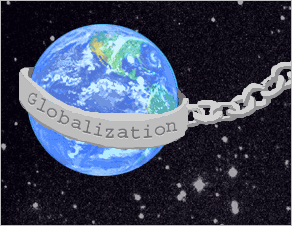
Globalization cartoon

http://www.geographyalltheway.com/ib_geography/ib_globalization/imagesetc/globalization.jpg
Tuesday, October 20, 2009
Friday, October 16, 2009
Friday, July 17, 2009
Tuesday, May 5, 2009
Tuesday, April 28, 2009
What I Have Learned This Semester ...
First, I have found a significant improvement in my ability to understand visual communication. Throughout my academic life, this is the first time I have moved away from my comfort zone, however, not to find any discomfort. I have started understanding the “whyness and howness” of different visual media. Colors, motions, and music have started making sense to me. Or, I have started taking components of visual design as “motivated signs.”
Throughout the semester, I was struggling through the complexities of the uses of different technological tools. The theoretical discussions in both the books (Practices and Grammar) are quite familiar to me as these theories are interdisciplinary in nature and are explored in other fields too. But the real purpose behind theories is always improvements in practices, which I had to struggle through all the way to the end of the semester. But, even if it was difficult, it was rewarding as well.
Regarding the ideas learnt from this course, the first idea is that of questioning the notion of “one to one correspondence between image and reality.” Or, different theories of visual communication have challenged the idea that photographic reality is the exact reproduction of the external reality. Rather, photography always selects something by deselecting the others, thereby distorting reality and offering a partial view. Second important idea is the notion of social construction of meaning of visual communication. Meaning is not produced only by the producer, it is also mediated and sometimes even interrogated by the audience or the viewers too. Visuals can be powerful means of constructing reality. But at the same time the manipulation of it can be equally so in exposing the ideology behind the construction of certain meaning or reality. The manipulation of the cowboy ad powerfully demonstrates how meaning of an image can subverted through some creative manipulation. This is what we learnt through our digital remix subproject.
Similarly, I found Grammar of Visual Design particularly interesting as it takes us through both the theoretical and the practical aspects of visual communication. It offers us insights into understanding colors, shapes, motions, and modality of images. This book really provides practical guidance to both the beginners in the field and the experts. Their discussion of visual language in terms of (verbal language) linguistics is both insightful and sometimes highly technical. But I really enjoyed reading it. It’s true that we can understand visual communication if we approach it as having its own grammar similar to that of language. I found the ideas of sign, conceptual and narrative representations, color symbolism, and the positioning of the material in images quite useful for me to understand the basics of visual communication.
Even if technological tools almost frustrated me, I could learn a lot and use them considerably well to accomplish different projects of the course. All the software were new to me. I learnt little bit photoshop in the beginning, but since I had to use that again while developing website, I really have got good footing on it. Moviemaker was not that difficult to learn. But dreamweaver was really frustrating. But with a lot of help from Michael Hovan, I could learn some basic stuff about it. Now, I can say that I can use these tools when necessary.
Overall, this course has been incredibly useful for me.
Throughout the semester, I was struggling through the complexities of the uses of different technological tools. The theoretical discussions in both the books (Practices and Grammar) are quite familiar to me as these theories are interdisciplinary in nature and are explored in other fields too. But the real purpose behind theories is always improvements in practices, which I had to struggle through all the way to the end of the semester. But, even if it was difficult, it was rewarding as well.
Regarding the ideas learnt from this course, the first idea is that of questioning the notion of “one to one correspondence between image and reality.” Or, different theories of visual communication have challenged the idea that photographic reality is the exact reproduction of the external reality. Rather, photography always selects something by deselecting the others, thereby distorting reality and offering a partial view. Second important idea is the notion of social construction of meaning of visual communication. Meaning is not produced only by the producer, it is also mediated and sometimes even interrogated by the audience or the viewers too. Visuals can be powerful means of constructing reality. But at the same time the manipulation of it can be equally so in exposing the ideology behind the construction of certain meaning or reality. The manipulation of the cowboy ad powerfully demonstrates how meaning of an image can subverted through some creative manipulation. This is what we learnt through our digital remix subproject.
Similarly, I found Grammar of Visual Design particularly interesting as it takes us through both the theoretical and the practical aspects of visual communication. It offers us insights into understanding colors, shapes, motions, and modality of images. This book really provides practical guidance to both the beginners in the field and the experts. Their discussion of visual language in terms of (verbal language) linguistics is both insightful and sometimes highly technical. But I really enjoyed reading it. It’s true that we can understand visual communication if we approach it as having its own grammar similar to that of language. I found the ideas of sign, conceptual and narrative representations, color symbolism, and the positioning of the material in images quite useful for me to understand the basics of visual communication.
Even if technological tools almost frustrated me, I could learn a lot and use them considerably well to accomplish different projects of the course. All the software were new to me. I learnt little bit photoshop in the beginning, but since I had to use that again while developing website, I really have got good footing on it. Moviemaker was not that difficult to learn. But dreamweaver was really frustrating. But with a lot of help from Michael Hovan, I could learn some basic stuff about it. Now, I can say that I can use these tools when necessary.
Overall, this course has been incredibly useful for me.
Saturday, April 25, 2009
Friday, April 24, 2009
Subscribe to:
Posts (Atom)